"I'm 15 for a moment..."
~
What we don't think about when we are worrying over the next test, crying over our latest grade, obsessing over how to get into an Ivy League is that we only live once, and this one life is too short. We hardly realize it when we say "I'm going to be a lawyer, doctor, scientist, engineer, CEO, etc." and I think most of us won't realize it until our kids are leaving for college and we suddenly realize we weren't ready to see them grow up just yet, or until we look in the mirror and realize our skin has lost its elasticity and is lined with wrinkles, or until we are on our deathbed and finally realize we are dying with so much left undone.
So I'd like to ask you, are you happy with what career you are pursuing? Are you pursuing it because it makes you happy? Are you doing this for yourself?
If you answered 'no' to all of the above, I suggest you reevaluate your choices. There's nothing wrong with wanting to have a stable job with a steady income, but don't let that be the only deciding factor. There's nothing worse than slaving away at a job you hate for 40 years.
Ask yourself what it is you truly want in this world and go for it. After all, we only have one life to be happy, daring, passionate, ambitious, in love, spontaneous, artistic, caring, funny, real, creative, philosophical, crazy, impulsive, to laugh, to cherish, to hold, to achieve, to dream, to smile, to chase, to enjoy, to wish, to make, to wonder, and to live. We are only here for a moment, for a breath. In a blink of an eye we are gone. The greatest success in this life is to be happy.
You only live once, so make it worth it.
~
"There's never a wish better than this, when you only got a 100 years to live."
("100 Years" by Five For Fighting)
Sunday, March 30, 2014

Sunday, March 23, 2014
On the Other Side of the Fence
Beyond the fence separating my backyard and my neighbors' there was a gigantic trampoline. I rubbed the sleep out of my bleary eyes in disbelief, yawning involuntarily. When I looked again, it was still there, smack dab in the middle of their spacious backyard resting on their flawless grass - the kind of grass you would only find on golf courses of country clubs, vivid green and uniformly clipped. The trampoline hadn't been there last night, and the monstrosity looked like it would take more than a day to put together. Yet there it stood at seven in the morning, under the rising sun, in all its matte black splendor. I downed the last dregs of my coffee before retreating inside and closed the terrace door behind me.
My new neighbors moved in only a few months ago. The house next door had been recently constructed and stood out awkwardly amongst the other residences in the neighborhood. It was massive and expensive just like all the other possessions that were unloaded from the three moving vans. The neighbors were quiet people, and they mostly kept to themselves. Their daughter looked about nine years old, and she was just as reclusive. I manned the lemonade stand during the annual summer block party and was expecting the little girl to show up with her parents in tow, but she never did. We finally met nearly a month after their arrival. As I was taking out the trash, I saw her sitting on the steps of her porch, a bored expression on her face. I gave her a warm smile and she answered my greeting with a sullen glare.
"What are you doing on such a nice day?" I asked, squinting my eyes in the blinding summer sun.
"Nothing," she replied.
I smiled once again. "There's a community pool right down the street. I could walk you over if you'd like."
She shrugged. "Don't wanna," she said and diverted her attention to the piece of technology she pulled out of her pocket. My eyes bugged out of my head in shock. A little nine year old was playing with the latest and the greatest smart phone that I could only dream of having.
Needless to say, our conversation pretty much ended after that. She ignored my attempts at socializing, and I eventually gave up and returned to my house. From what I could tell, her parents spoiled her. Besides the trampoline and smart phone, she was also gifted with a shiny red bike, a scooter, a set of swings, and just about everything else under the sun a little kid could want. Yet every time I saw her, she looked like the most miserable kid in the world. I couldn't help but find her an ungrateful brat, and I have to admit it was partially because I felt a bit envious; I wished my childhood had been as blessed as hers is. After than incident, I only saw her in passing. I would always wave, and very rarely she would answer with a halfhearted little wave of her own. Those were her good days.
We had our real conversation a few months later on Halloween night. I had finished passing out candy, and I went out onto my back porch for some fresh air. I found her lying on her trampoline, staring up at the stars.
"Hey!" I called out. "How are your spoils? Did you get a lot of candy?"
She sat up and looked at me, her eyes blinking owlishly. "I didn't go trick-or-treating."
I frowned at this. "I have some leftover candy," I said, waving her over. "You can have it."
I half expected her to refuse like usual and go back to stargazing, but instead she actually got up and climbed over the fence into my yard. I smiled and invited her into my kitchen where the tub of candy sat on the granite counter.
"Help yourself," I said.
She began eating the candy silently, her face expressionless the entire time. No smile. Not at all. It began to unnerve me, and finally, I could no longer contain it.
"What's wrong?" I asked. She stopped mid-chew and looked at me inquiringly.
"Do you not like the candy or something?" I clarified.
"It's fine."
"Then what's the problem?"
"Problem?"
I huffed and frowned. I knew I was being a little too harsh with a girl I barely even knew, but I couldn't help myself. "You're always sad and frowning as if there's nothing to be happy about, and I just don't get it."
She didn't answer me; she just sat at my counter with her hands folded neatly in her lap, her eyes watching me. That was the last straw.
"I don't get it," I continued. "You have all they toys you could ever want, and yet you always wear this dissatisfied expression on your face. It's really depressing, don't you know? Gosh, you should try and act a little more grateful. I never had any of the stuff that you had. I wish I had it as great as you."
I stopped myself then. It was embarrassing how easily I lost my control, but I couldn't help but feel satisfied for saying what that she should have been told a long time ago. She was quiet after that, and she eventually lowered her gaze to her lap. I felt more and more uneasy with each minute that ticked by. It really wasn't any of my business, even if I was right. It opened my mouth to tell her to forget it, to fill the silence, anything -
"You don't get it," she suddenly said, and with horror I realized her voice was wet with tears. When she looked up, I saw her eyes were red and her cheeks all blotchy.
"You want this? Why would you ever want this?" she asked, her voice thick with a deep, unwavering sadness. "Everything they give me is to make up for all the times they missed my birthday, Christmas, my play, my choir concert. It's for all of the times they aren't there. They are never there."
I stood there dumbfounded, feeling small and insignificant in my cramped kitchen. Everything suddenly became impossibly clear, but it was already too late. The damage was done, my words couldn't be unsaid, and I listened to her quiet sobs reach deep within me and tear at my heartstrings.
My new neighbors moved in only a few months ago. The house next door had been recently constructed and stood out awkwardly amongst the other residences in the neighborhood. It was massive and expensive just like all the other possessions that were unloaded from the three moving vans. The neighbors were quiet people, and they mostly kept to themselves. Their daughter looked about nine years old, and she was just as reclusive. I manned the lemonade stand during the annual summer block party and was expecting the little girl to show up with her parents in tow, but she never did. We finally met nearly a month after their arrival. As I was taking out the trash, I saw her sitting on the steps of her porch, a bored expression on her face. I gave her a warm smile and she answered my greeting with a sullen glare.
"What are you doing on such a nice day?" I asked, squinting my eyes in the blinding summer sun.
"Nothing," she replied.
I smiled once again. "There's a community pool right down the street. I could walk you over if you'd like."
She shrugged. "Don't wanna," she said and diverted her attention to the piece of technology she pulled out of her pocket. My eyes bugged out of my head in shock. A little nine year old was playing with the latest and the greatest smart phone that I could only dream of having.
Needless to say, our conversation pretty much ended after that. She ignored my attempts at socializing, and I eventually gave up and returned to my house. From what I could tell, her parents spoiled her. Besides the trampoline and smart phone, she was also gifted with a shiny red bike, a scooter, a set of swings, and just about everything else under the sun a little kid could want. Yet every time I saw her, she looked like the most miserable kid in the world. I couldn't help but find her an ungrateful brat, and I have to admit it was partially because I felt a bit envious; I wished my childhood had been as blessed as hers is. After than incident, I only saw her in passing. I would always wave, and very rarely she would answer with a halfhearted little wave of her own. Those were her good days.
We had our real conversation a few months later on Halloween night. I had finished passing out candy, and I went out onto my back porch for some fresh air. I found her lying on her trampoline, staring up at the stars.
"Hey!" I called out. "How are your spoils? Did you get a lot of candy?"
She sat up and looked at me, her eyes blinking owlishly. "I didn't go trick-or-treating."
I frowned at this. "I have some leftover candy," I said, waving her over. "You can have it."
I half expected her to refuse like usual and go back to stargazing, but instead she actually got up and climbed over the fence into my yard. I smiled and invited her into my kitchen where the tub of candy sat on the granite counter.
"Help yourself," I said.
She began eating the candy silently, her face expressionless the entire time. No smile. Not at all. It began to unnerve me, and finally, I could no longer contain it.
"What's wrong?" I asked. She stopped mid-chew and looked at me inquiringly.
"Do you not like the candy or something?" I clarified.
"It's fine."
"Then what's the problem?"
"Problem?"
I huffed and frowned. I knew I was being a little too harsh with a girl I barely even knew, but I couldn't help myself. "You're always sad and frowning as if there's nothing to be happy about, and I just don't get it."
She didn't answer me; she just sat at my counter with her hands folded neatly in her lap, her eyes watching me. That was the last straw.
"I don't get it," I continued. "You have all they toys you could ever want, and yet you always wear this dissatisfied expression on your face. It's really depressing, don't you know? Gosh, you should try and act a little more grateful. I never had any of the stuff that you had. I wish I had it as great as you."
I stopped myself then. It was embarrassing how easily I lost my control, but I couldn't help but feel satisfied for saying what that she should have been told a long time ago. She was quiet after that, and she eventually lowered her gaze to her lap. I felt more and more uneasy with each minute that ticked by. It really wasn't any of my business, even if I was right. It opened my mouth to tell her to forget it, to fill the silence, anything -
"You don't get it," she suddenly said, and with horror I realized her voice was wet with tears. When she looked up, I saw her eyes were red and her cheeks all blotchy.
"You want this? Why would you ever want this?" she asked, her voice thick with a deep, unwavering sadness. "Everything they give me is to make up for all the times they missed my birthday, Christmas, my play, my choir concert. It's for all of the times they aren't there. They are never there."
I stood there dumbfounded, feeling small and insignificant in my cramped kitchen. Everything suddenly became impossibly clear, but it was already too late. The damage was done, my words couldn't be unsaid, and I listened to her quiet sobs reach deep within me and tear at my heartstrings.
Sunday, March 16, 2014
By All Means, PROCEED With Caution
Pandora Sitting on the Box
After reading Chet Raymo's "A Measure of Restraint," I was reminded of the Greek mythology book my dad bought for me when I was eleven. What immediately came to mind was the image of my younger self snug underneath the covers and pretending to be asleep, clutching my book and flashlight while my eyes flew rapidly across the page. I enjoyed all of the stories, but there was a particular one that made quite an impression on me: Pandora's Box. It was essentially the age old saying "curiosity killed the cat," except the cat was a young woman, and curiosity didn't kill her but instead condemned all of mankind to be plagued by the seven deadly sins. So, little Miss Pandora was a little too eager in finding out the box's contents and ignored all of the warnings - "Do NOT open the box!" - which ended badly for basically everyone else. I understand Raymo wants to warn others and save them from falling into the same trap as Pandora did, but I can't help but wonder about the scientists who do know the risks and still choose to pursue their research in the name of science. Take the Wright Brothers, for example. I'm positive they knew of the risks that came with the creation of airplanes i.e. you fall out of the sky and die. Yet they were willing to take that risk. Though some may argue that the planes were "detrimental to society and became instruments of warfare," ultimately they were of huge benefit and greatly enhanced our mobility. Even though there may be dangers lurking on our quest for knowledge, sometimes we need to take risks in order to advance civilization. If our ancestors hadn't play with fire, we would still be shivering in the caves right now.
Yes, there is a fine line between being Pandora opening the box and Benjamin Franklin flying his kite during a thunderstorm, but take Raymo's warning with "a measure of restraint." Limits are set to prevent us from abusing power, not to bind us from moving forward.
After reading Chet Raymo's "A Measure of Restraint," I was reminded of the Greek mythology book my dad bought for me when I was eleven. What immediately came to mind was the image of my younger self snug underneath the covers and pretending to be asleep, clutching my book and flashlight while my eyes flew rapidly across the page. I enjoyed all of the stories, but there was a particular one that made quite an impression on me: Pandora's Box. It was essentially the age old saying "curiosity killed the cat," except the cat was a young woman, and curiosity didn't kill her but instead condemned all of mankind to be plagued by the seven deadly sins. So, little Miss Pandora was a little too eager in finding out the box's contents and ignored all of the warnings - "Do NOT open the box!" - which ended badly for basically everyone else. I understand Raymo wants to warn others and save them from falling into the same trap as Pandora did, but I can't help but wonder about the scientists who do know the risks and still choose to pursue their research in the name of science. Take the Wright Brothers, for example. I'm positive they knew of the risks that came with the creation of airplanes i.e. you fall out of the sky and die. Yet they were willing to take that risk. Though some may argue that the planes were "detrimental to society and became instruments of warfare," ultimately they were of huge benefit and greatly enhanced our mobility. Even though there may be dangers lurking on our quest for knowledge, sometimes we need to take risks in order to advance civilization. If our ancestors hadn't play with fire, we would still be shivering in the caves right now.
Yes, there is a fine line between being Pandora opening the box and Benjamin Franklin flying his kite during a thunderstorm, but take Raymo's warning with "a measure of restraint." Limits are set to prevent us from abusing power, not to bind us from moving forward.
Sunday, March 9, 2014
Florence Kelley Puzzle Paragraph
On July 22, 1905 in Philadelphia, Florence Kelley stood before the convention of the NAWSA delivered a powerful speech against child labor and for women's suffrage. Her speech is an example of one of the finest persuasive essays. She cleverly weaved the fight for women's suffrage into her argument, stating that enfranchising women will be the only way to stop the cruelties of child labor. Children and women are often mistreated because they are viewed as weak. Laws protecting women's rights and laws abolishing child labor are often connected; for those nations having confronted these issues, few have adopted one law without the other. Kelley's rhetoric is so effective because she uses this connection to further her point: a woman's right to vote is crucial to protecting children in the workplace.
Although child labor and women's suffrage are no longer issues in the United States, Kelley's speech is still relevant today. Americans may easily overlook the fact that the stuffed pink elephants they buy for their children could very likely have been made by a child in another country. Countless nations have yet to establish laws protecting children and women. For instance, in India where child labor still exists, there are high rates of rape and horrible treatment of women. So long this inequality and cruelty remain, there is still much to learn from Kelley's piece. It is important for women to feel empowered to take back what is rightfully theirs and their children's. They cannot be meek and hide at home, praying for some divine intervention whether it be Jesus or Allah, but instead they must continue to fight with the will to win.
Hopefully one day in the future, when this is far behind us everyone will look back at the times when women and children were mistreated and find it as unbelievable as tales that begin with "Once upon a time..." It is only then can Kelley's piece have its true happily ever after.
Although child labor and women's suffrage are no longer issues in the United States, Kelley's speech is still relevant today. Americans may easily overlook the fact that the stuffed pink elephants they buy for their children could very likely have been made by a child in another country. Countless nations have yet to establish laws protecting children and women. For instance, in India where child labor still exists, there are high rates of rape and horrible treatment of women. So long this inequality and cruelty remain, there is still much to learn from Kelley's piece. It is important for women to feel empowered to take back what is rightfully theirs and their children's. They cannot be meek and hide at home, praying for some divine intervention whether it be Jesus or Allah, but instead they must continue to fight with the will to win.
Hopefully one day in the future, when this is far behind us everyone will look back at the times when women and children were mistreated and find it as unbelievable as tales that begin with "Once upon a time..." It is only then can Kelley's piece have its true happily ever after.
Sunday, March 2, 2014
Schemas and Logic
schema: n.
A schema is a cognitive framework or concept that helps organize and interpret information. Schemas can be useful because they allow us to take shortcuts in interpreting the vast amount of information that is available in our environment. However, these mental frameworks also cause us to exclude pertinent information to instead focus only on things that confirm our pre-existing beliefs and ideas. Schemas can contribute to stereotypes and make it difficult to retain new information that does not conform to our established ideas about the world. (About.com)
~
From the time of our birth, we are constantly observing the world, interpreting new situations, and subconsciously incorporating our experiences into our schemas. Our schemas act as necessary guides; without them, the world would be a mass of confusion. We wouldn't be able to properly function if we had to remember every exception because our minds would become muddled and confused from the overwhelming amount of information. Thus, we learn to discriminate one thing from another, categorize them, and make generalizations in order to understand our world. And yes, this can be extremely limiting when we try to acquire new information and adapt to new situations, but it is a part of human nature.
It would be easy for me to criticize the white woman who mistook Brent Staples for a mugger or a rapist, but in her shoes I probably would have reacted the same way. Frankly, I'd be apprehensive of anyone who was walking behind me on a deserted street, especially if it was at night.
So, was she really in the wrong? What about the jewelry saleswoman who assumed Staples was a robber or the policemen who assumed the black journalist was a murderer? Were they in the wrong too?
Statistically speaking, no they were not in the wrong; there are high rates of crime and violence in African American men. However, logically speaking, they were wrong because Brent Staples is not a rapist, is not a mugger, and is not a thief. The black journalist was also not the murderer the police thought him to be. These people had incorporated the statistic into their schemas, unconsciously creating an unyielding stereotype that all black men are criminals, and all made mistakes of varying severity. The white woman's mistake was the least severe. Even though she may have made an error in judgement, she was acting in fear and self-preservation, and given the circumstances if Staples actually was a mugger, the odds would not have been in her favor. Unfortunately, I cannot condone the actions of the policemen and the saleswoman, nor can I blame their schemas for their mistakes. While we do have schemas understand the world, it does not mean we can ignore logic and reason. While we do generalize, it does not mean we can ignore the fact that there are exceptions to every rule. The policemen and the saleswoman depended only on their schemas and by doing so, they committed logical fallacies which wronged two very innocent men.
~
Schemas are innate; that is something irreversible. So is it possible to completely eradicate people's misconceptions and stereotypes? No it is not.
But schemas are not at fault. While they make adapting more difficult, they are necessary in thinking and understanding. The only fault is to rely solely on them and to cast logic aside because without logic and reason, we become irrational and stupid creatures.
Now, I'll leave you with one last thought du jour: with logic and reason, you can assimilate new experiences and accommodate your schemas to fit them. Nothing is ever set in stone.
A schema is a cognitive framework or concept that helps organize and interpret information. Schemas can be useful because they allow us to take shortcuts in interpreting the vast amount of information that is available in our environment. However, these mental frameworks also cause us to exclude pertinent information to instead focus only on things that confirm our pre-existing beliefs and ideas. Schemas can contribute to stereotypes and make it difficult to retain new information that does not conform to our established ideas about the world. (About.com)
~
From the time of our birth, we are constantly observing the world, interpreting new situations, and subconsciously incorporating our experiences into our schemas. Our schemas act as necessary guides; without them, the world would be a mass of confusion. We wouldn't be able to properly function if we had to remember every exception because our minds would become muddled and confused from the overwhelming amount of information. Thus, we learn to discriminate one thing from another, categorize them, and make generalizations in order to understand our world. And yes, this can be extremely limiting when we try to acquire new information and adapt to new situations, but it is a part of human nature.
It would be easy for me to criticize the white woman who mistook Brent Staples for a mugger or a rapist, but in her shoes I probably would have reacted the same way. Frankly, I'd be apprehensive of anyone who was walking behind me on a deserted street, especially if it was at night.
So, was she really in the wrong? What about the jewelry saleswoman who assumed Staples was a robber or the policemen who assumed the black journalist was a murderer? Were they in the wrong too?
Statistically speaking, no they were not in the wrong; there are high rates of crime and violence in African American men. However, logically speaking, they were wrong because Brent Staples is not a rapist, is not a mugger, and is not a thief. The black journalist was also not the murderer the police thought him to be. These people had incorporated the statistic into their schemas, unconsciously creating an unyielding stereotype that all black men are criminals, and all made mistakes of varying severity. The white woman's mistake was the least severe. Even though she may have made an error in judgement, she was acting in fear and self-preservation, and given the circumstances if Staples actually was a mugger, the odds would not have been in her favor. Unfortunately, I cannot condone the actions of the policemen and the saleswoman, nor can I blame their schemas for their mistakes. While we do have schemas understand the world, it does not mean we can ignore logic and reason. While we do generalize, it does not mean we can ignore the fact that there are exceptions to every rule. The policemen and the saleswoman depended only on their schemas and by doing so, they committed logical fallacies which wronged two very innocent men.
~
Schemas are innate; that is something irreversible. So is it possible to completely eradicate people's misconceptions and stereotypes? No it is not.
But schemas are not at fault. While they make adapting more difficult, they are necessary in thinking and understanding. The only fault is to rely solely on them and to cast logic aside because without logic and reason, we become irrational and stupid creatures.
Now, I'll leave you with one last thought du jour: with logic and reason, you can assimilate new experiences and accommodate your schemas to fit them. Nothing is ever set in stone.
Sunday, February 23, 2014
The Expression of Love
Words
Verbally expressing your love for someone is the both easiest and the most difficult thing to do.
It is one of the bravest acts in this world because sometimes it will end in rejection, a pain which stabs so thoroughly at the most vulnerable spot in your body: the heart.When you tell them you love them, you are laying yourself bare and opening yourself to the possibility of being hurt. However, it can also be instantly gratifying if they love you back, and that feeling is the most rewarding.
Actions
Expressing your love through actions - and by this I don't mean hugs or hand holding - is difficult and easy in entirely different ways.
It is easy in the way that you are not directly opening yourself up to possible rejection. However, because the range of things that people do for their loved ones is so broad, the love is very hard to identify. Being misunderstood is even sometimes worse than being outright rejected. Although, if one does show his love through action, it can be even more sincere than words. Often times, actions do speak louder than words because while it may take a lot of courage to verbally confess, the effect is instantaneous. Actions on the other hand require a great deal of effort over an undefined period of time.
The Perfect Balance
True love cannot be one or the other; it needs to be a mix of both. Sometimes words are necessary to reaffirm your love when actions are too vague. Other times actions are more genuine and convey more strength than the words "I love you."
Verbally expressing your love for someone is the both easiest and the most difficult thing to do.
It is one of the bravest acts in this world because sometimes it will end in rejection, a pain which stabs so thoroughly at the most vulnerable spot in your body: the heart.When you tell them you love them, you are laying yourself bare and opening yourself to the possibility of being hurt. However, it can also be instantly gratifying if they love you back, and that feeling is the most rewarding.
Actions
Expressing your love through actions - and by this I don't mean hugs or hand holding - is difficult and easy in entirely different ways.
It is easy in the way that you are not directly opening yourself up to possible rejection. However, because the range of things that people do for their loved ones is so broad, the love is very hard to identify. Being misunderstood is even sometimes worse than being outright rejected. Although, if one does show his love through action, it can be even more sincere than words. Often times, actions do speak louder than words because while it may take a lot of courage to verbally confess, the effect is instantaneous. Actions on the other hand require a great deal of effort over an undefined period of time.
The Perfect Balance
True love cannot be one or the other; it needs to be a mix of both. Sometimes words are necessary to reaffirm your love when actions are too vague. Other times actions are more genuine and convey more strength than the words "I love you."
Tuesday, February 18, 2014
Claude Monet's Impression, Sunrise
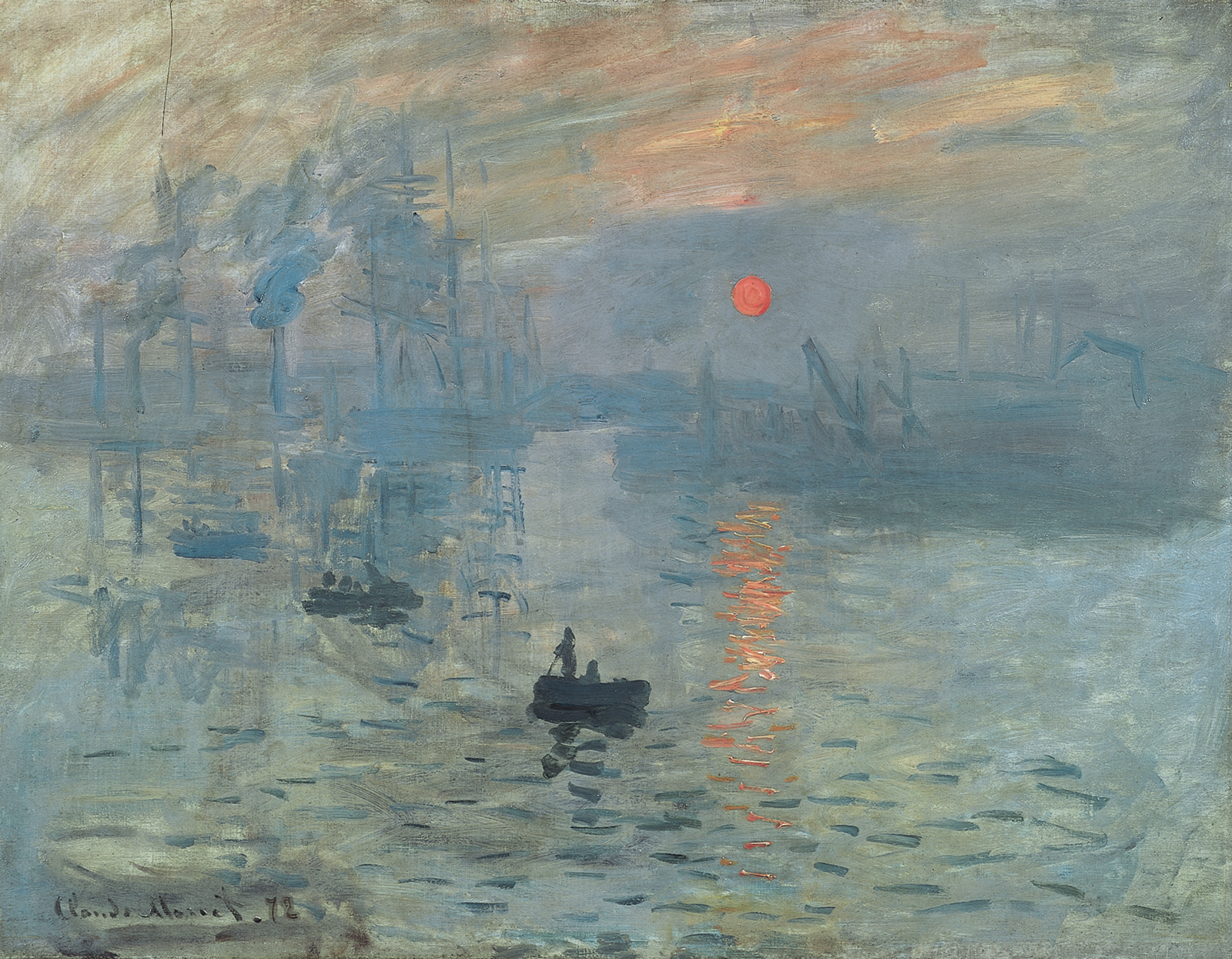
on the cool waters that are not yet warm from the rising sun
that slowly emerges from the depths of the sea and into
the misty, gray sky. Even with the light of daybreak
it's still too dark outside, and the boats look like mere
shadows floating along the waves. It's far too early for him
to be out of bed, he thinks, half-dozing with his back
against the side of their small fishing boat. The air is still cold
and damp, and he wouldn't be out here in the first place
if his big brother hadn't asked for his company. He'd much
rather be wrapped up in his warm sheets, waiting for the
warmth of the afternoon sun, lost in his sea of dreams. But
then he's all too awake because he suddenly remembers.
Today is the last day they will ever be like this because tomorrow
his brother will be gone. His bags will be packed and their
cramped room that smells like the sea will be stripped
and empty on one side. His brother will be gone because
he has chosen to leave him, their parents - everyone - far,
far behind for something bigger, better. They were
never good enough for his all big talk of ambitions, dreams,
and futures. A part of him resents him for it and probably
always will...but as he looks up at his brother who is standing tall
at the steer of their little, rocking boat like the mast of a majestic ship,
and he also understands - he understands
there is nothing in this sleepy, little town for his big brother.
His big brother who is tall, broad-shouldered, and determined
can't live forever in a place shrouded by fog, a place that
can never truly see the sun. And then he wants to apologize.
His brother knows he's angry - that's why he asked him to
accompany him this morning - but it's not so much that he's angry
- maybe a little jealous - but mostly scared and sad that
the person closest to him will have already vanished by this time
tomorrow. He doesn't know what to say or do because
he suddenly feels stupid and embarrassed and so overcome
with the world that all he wants to do is to sob like a
little boy waiting for his big brother to comfort him. But he can't
because he feels frozen as if he's glued to his seat, and he can
barely breathe, let along speak. He wonders if his brother
feels the same, if he's just as nervous and scared and maybe
a little pained at the thought of leaving him too. But his big brother
continues to stand motionless at his side as he continues to sit
and ruminate in silence, dreading tomorrow, the day when
everything will change.
Subscribe to:
Comments (Atom)